
Mauritius offers world-class whale watching from July to November. Discover the best tours, what species to expect, essential tips, and how to plan an unforgettable whale watching experience off the west coast.
Every year between July and November, the warm waters off the west coast of Mauritius become a highway for some of the ocean most magnificent creatures. Humpback whales, sperm whales, and occasionally other cetacean species pass through these waters on their annual migration, offering visitors a chance to witness one of nature greatest spectacles.
Whale watching in Mauritius has grown from a niche activity into one of the island most sought-after experiences. The deep waters close to shore, experienced operators, and high success rates make Mauritius one of the best whale watching destinations in the Indian Ocean. This comprehensive guide covers everything you need to plan your whale watching adventure.
## Which Whales Visit Mauritius?
### Humpback Whales — The Stars of the Show
Humpback whales are the main attraction during whale watching season in Mauritius. These magnificent creatures migrate from their feeding grounds in Antarctica to the warm tropical waters of the Indian Ocean to breed and give birth.
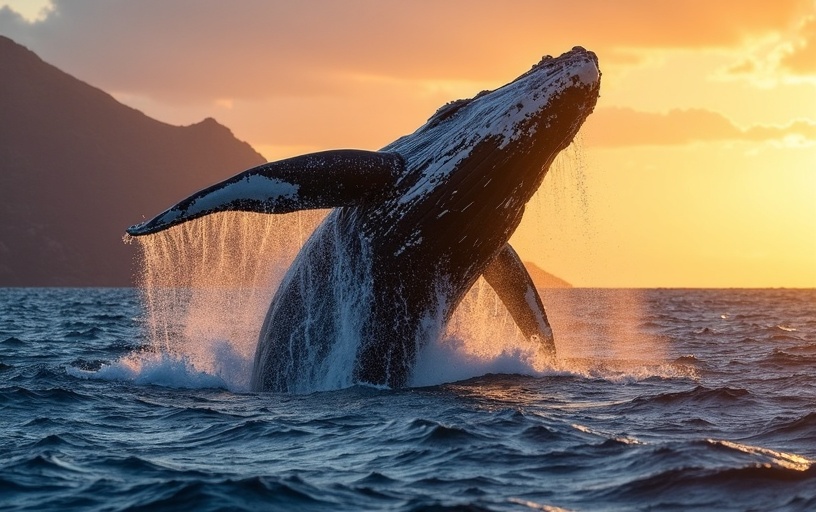
Humpbacks are among the most acrobatic of all whale species. They are famous for their spectacular breaches — launching their 30-40 ton bodies completely out of the water before crashing back with an enormous splash. They also perform tail slaps, pectoral fin waves, and spy-hopping (raising their heads vertically out of the water to look around).
Adult humpbacks reach 14-17 meters in length and weigh 25-40 tons. Despite their massive size, they are surprisingly graceful. Their long pectoral fins (up to 5 meters — the longest of any whale species) give them exceptional maneuverability.
One of the most remarkable aspects of humpback whales is their singing. Males produce complex songs that can last 20 minutes and be heard from kilometers away. These songs are believed to play a role in mating. Some tour operators use hydrophones to let passengers listen to whale songs underwater — a hauntingly beautiful experience.
Mother-calf pairs are commonly seen in Mauritian waters. Calves are born weighing about 1 ton and 4 meters long. They grow rapidly on their mother rich milk, gaining about 45 kg per day. Watching a mother gently guiding her calf is one of the most moving wildlife experiences possible.
### Sperm Whales — The Deep Divers
Sperm whales can be spotted year-round in the deep waters off the west coast, though they are more commonly seen between November and March. These are the largest toothed whales on Earth, with males reaching 18 meters and weighing up to 57 tons.
Sperm whales are legendary divers, capable of descending to 2,000 meters and holding their breath for over 90 minutes. They hunt giant squid in the pitch-black depths — a battle that happens far below the surface and has never been fully observed by humans.
Their distinctive square heads make up one-third of their body length and contain the spermaceti organ, which produces a waxy substance once highly prized by whalers. Their blow is angled forward and to the left, making them easy to identify from a distance.
Sperm whales spend most of their time underwater, surfacing for 8-10 minutes between dives. When they dive, they raise their massive tail flukes high in the air — a dramatic sight that photographers love.
### Other Species
While humpbacks and sperm whales are the most commonly seen, Mauritian waters are home to over 20 cetacean species. Beaked whales, pilot whales, and Bryde whales are occasionally spotted. Orcas (killer whales) have been recorded but are extremely rare.
## When Is Whale Watching Season?
The primary whale watching season in Mauritius runs from **July to November**, coinciding with the humpback whale migration.
**July-August (Early Season):** Humpback whales begin arriving from Antarctica. Sightings increase throughout July. The whales are often traveling, so you may see them moving through the area. Success rates are around 60-70%.
**September-October (Peak Season):** This is the best time for whale watching. Humpbacks are present in large numbers, and many are breeding or have recently given birth. Mother-calf pairs are common. Breaching activity is at its highest. Success rates exceed 80%.
**November (Late Season):** Whales begin their return journey south. Numbers decrease but sightings are still possible. Late-season tours sometimes encounter whales with very young calves. Success rates drop to 50-60%.
**December-June (Off Season):** Humpback whales are absent, but sperm whales can be spotted year-round. Dedicated sperm whale tours are available but less common. Success rates for sperm whales are lower (40-50%) as they spend most of their time deep underwater.
## Where Do Whale Watching Tours Depart From?
Most whale watching tours depart from the **west coast** of Mauritius, specifically from Tamarin, Black River, or Le Morne. The west coast is ideal because the deep ocean is close to shore — the continental shelf drops off steeply just a few kilometers from the coast.
This proximity to deep water means shorter boat rides to reach whale territory. Most tours find whales within 30-60 minutes of departure, compared to hours at some other whale watching destinations.
The west coast also offers calmer seas than the east coast (which is exposed to trade winds), making for a more comfortable boat ride. The dramatic backdrop of Le Morne mountain and the Black River mountains adds to the scenic experience.
## What to Expect on a Whale Watching Tour
### The Boat
Whale watching tours use various vessel types. Speed boats (RIBs) are the most common — they are fast, maneuverable, and can reach whale sighting areas quickly. Some operators use larger catamarans, which are more stable and comfortable but slower.
More Marine Wildlife Experiences
Best Dolphin Swim Tour in Mauritius: What You Need to Know
Swim with wild spinner dolphins at Tamarin Bay — the perfect morning activity before whale watching season.
Read article →Dolphin & Whale Watching in Mauritius: What to Expect
Full species guide covering all cetaceans found in Mauritius, with ethical watching tips.
Read article →Speed boats typically carry 8-12 passengers, creating an intimate experience. Catamarans can carry 20-40 passengers. Smaller boats generally offer better viewing opportunities as you are closer to the water and can maneuver more easily.
### Finding the Whales
The crew uses a combination of experience, local knowledge, and visual scanning to find whales. They look for blows (the spray when whales exhale at the surface), which can be seen from several kilometers away on calm days.
Some operators communicate with other boats to share sighting information. Marine biologists on board may use acoustic equipment (hydrophones) to listen for whale songs, which can be detected from great distances.
Once a whale is located, the boat approaches slowly and carefully, following strict guidelines. The captain maintains a minimum distance of 100 meters (300 meters for mother-calf pairs) and approaches from the side, never head-on.
### The Encounter
When you first see a whale, the scale is difficult to comprehend. A humpback whale surfacing just 100 meters from your boat is an awe-inspiring sight. The blow — a powerful exhalation that sends a column of spray 3-4 meters into the air — is often the first sign.
The whale may surface several times in succession, breathing 4-8 times before diving. Each surfacing reveals more of the animal — the knobby head, the long pectoral fins, the barnacle-encrusted skin. When it dives, the massive tail flukes rise gracefully from the water.
If you are lucky, you will witness a breach. A 40-ton whale launching itself out of the water is one of the most spectacular sights in nature. The splash can be heard from hundreds of meters away. Breaching is unpredictable — it can happen at any moment, so keep your camera ready.
Other behaviors you might see include tail slapping (repeatedly slapping the tail on the water surface), pectoral fin slapping (waving the long fins above the water), spy-hopping (raising the head vertically to look around), and logging (resting motionless at the surface).
### Duration
Whale watching tours typically last 3-4 hours. The boat spends 1-2 hours with whales (moving between different individuals or pods) and the rest of the time traveling to and from whale territory.
Some operators combine whale watching with dolphin watching (early morning) or snorkeling, creating a half-day marine wildlife experience.
## Tips for an Amazing Whale Watching Experience
### Before You Go
Book during peak season (September-October) for the highest success rates. Choose a reputable operator with experienced crews and good reviews. Ask about their approach to whale welfare and conservation guidelines.
Take motion sickness medication 30-60 minutes before departure if you are prone to seasickness. The open ocean can be choppy, especially on speed boats.
Charge your camera batteries and clear memory cards. You will want to take hundreds of photos. A camera with a zoom lens (200-300mm) is ideal for boat-based photography.
### On the Boat
Dress in layers — mornings can be cool on the water, but it warms up quickly. Bring a waterproof jacket for spray. Wear a hat with a chin strap and sunglasses with a strap.
Apply sunscreen before boarding and reapply regularly. The reflection off the water intensifies UV exposure.
Listen to the crew. They know whale behavior and can predict when and where a whale will surface. Follow their pointing and instructions for the best viewing.
Be patient. Whale watching requires patience. You may see whales immediately or spend an hour searching. The ocean is vast, and whales are wild animals. Even experienced crews have days when sightings are limited.
### Photography Tips
Use a fast shutter speed (1/1000s or faster) to freeze action. Whales move quickly, and the boat is moving too. A fast shutter speed prevents blur.
Shoot in burst mode when a whale surfaces. You never know when a breach will happen, and burst mode increases your chances of capturing the perfect moment.
Include the landscape in some shots. Le Morne mountain or the coastline in the background adds context and drama to your whale photos.
Do not use flash. It can startle whales and is ineffective at the distances involved.
Plan Your West Coast Adventure
## Ethical Whale Watching
Responsible whale watching is essential for protecting these magnificent animals. The Mauritius government and marine conservation organizations have established guidelines that all operators should follow.
Boats must maintain a minimum distance of 100 meters from whales (300 meters for mother-calf pairs). No more than 3 boats should be within 300 meters of a whale at any time. Boats must approach from the side, never head-on or from behind.
Engines should be in neutral or at low speed when near whales. Time with each whale or pod should be limited to 30 minutes. Swimming with whales is not permitted in Mauritius.
Choose operators who follow these guidelines strictly. Report any violations to the Mauritius Marine Conservation Society.
## Frequently Asked Questions
**What are the chances of seeing whales?**
During peak season (September-October), success rates exceed 80%. Early and late season rates are 50-70%. Sperm whale sightings year-round are 40-50%.
**Can I swim with whales in Mauritius?**
No, swimming with whales is not permitted in Mauritius. This is for the safety of both humans and whales. You observe from the boat at a respectful distance.
**Is whale watching suitable for children?**
Yes, but consider the boat ride. Open-ocean trips on speed boats can be bumpy and last 3-4 hours. Children under 5 may find it uncomfortable. Older children usually love the experience.
**What if we do not see any whales?**
Most operators offer a partial refund or free rebooking if no whales are sighted. Check the policy when booking. Even without whale sightings, you may see dolphins, sea turtles, or other marine life.
**How close do whales come to the boat?**
Boats maintain a minimum 100-meter distance, but whales sometimes approach boats voluntarily. Curious whales may swim within 20-30 meters of the boat — a thrilling experience.
**Do I need binoculars?**
Binoculars are helpful for spotting distant blows and identifying whale behavior. However, when whales are close, the naked eye (or camera zoom) is sufficient.
## Why Book Your Whale Watching Tour With Us
Our whale watching tours are led by experienced captains who have spent years studying whale behavior in Mauritian waters. We follow strict ethical guidelines, maintain safe distances, and prioritize animal welfare above all else.
Our boats are equipped with modern safety equipment, and our crews are trained in first aid and emergency procedures. We keep group sizes small for a better experience and provide educational commentary about whale biology and conservation.
We offer flexible booking with free cancellation up to 24 hours before departure. If no whales are sighted, we offer a complimentary rebooking for another date.
Book your whale watching tour today and witness one of nature most spectacular shows. The humpback whales of Mauritius are waiting to take your breath away.
For more marine wildlife experiences, read our guide on Dolphin Swimming Tours. If you want to combine whale watching with other activities, check out our West Coast Catamaran Cruises.
Related Activities You Might Enjoy
Get Mauritius Travel Tips in Your Inbox
Join 5,000+ travelers receiving weekly insider tips, exclusive deals, and destination guides.